
A free guide for UX & product designers
“It does not know when it does not know. Confidence tells you nothing about correctness.”
“AI works on the problem you hand it. It will not ask whether that problem should be there.”
Everyone is handing you rotten AI advice. This is the one worth taking.
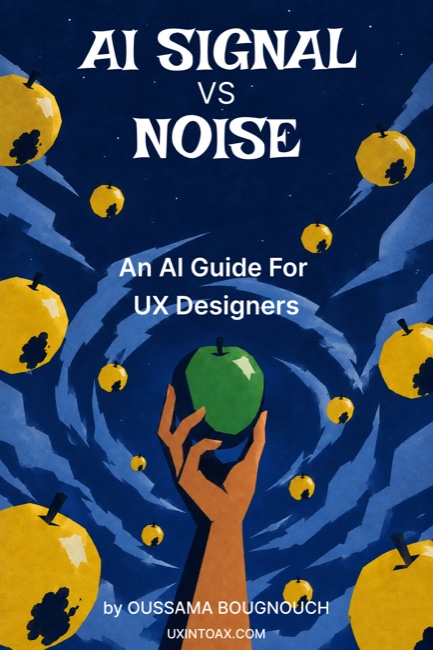
Eleven short chapters on what AI is really doing under the hood, written by a designer who ships with it. About an hour to read.
Free, no card, no shipping. Arrives in about a minute.
It is not answering your question. It is producing text shaped like an answer.
It can only work with what is in front of it. Deciding what goes there is the craft.
Size raises your ceiling, not your floor. A whale drowning in noise loses to a shark asking the right question.
Let it read. You decide.
It designs the happy path beautifully. Products are mostly the other paths.
What you will be able to do by the end
Not theory. Things you can use on your next project, this week.
- Understand the single thing a model is doing every time it answers you, and watch every strange result you have ever seen suddenly make sense. (Ch. 1)
- Spot the confident invention, and learn the one habit that catches it every time. (Ch. 2)
- Know why what you paste in matters far more than how you word the request. (Ch. 3)
- Climb the data food chain that quietly decides how senior your work looks, before you ever open Figma. (Ch. 4)
- Turn a pile nobody has read into a roadmap. Tickets, reviews, cancellation reasons, thousands of them, in days. (Ch. 4)
- Reach the one level of listening to a user that AI cannot get to. (Ch. 5)
- Avoid the four places AI quietly ruins design work: generated screens, critique, microcopy and accessibility. (Ch. 7)
- Build the verification habit that came out of the night my own agent told me it had finished 113 files. It had finished 53. (Ch. 8)
- Say out loud which parts of your job are safe, and why. (Ch. 6 & 9)
- Run a model on your own machine when the data cannot leave the building. (Ch. 10 & 11)
Why I wrote it
I spent thirteen years getting good at something, then watched everyone announce it was over.
You know the posts. Designers are finished. Learn to prompt or get replaced. Usually attached to a course.
I did not want to argue with it or ignore it. I wanted to know if it was true, so I did what we do with any unfamiliar system: I opened it up and looked at how it works.
What I found was not what either camp is selling. Machines really did get fast at the surface: the layout, the first draft, the tidy summary. But they did not get good at the part underneath. They cannot tell which of fifteen findings matters. They cannot know your users are pharmacists working under time pressure with gloves on. They cannot sit in a room and say the feature should not be built at all.
That part is what you have been quietly building for years. You have just never had to name it, because nothing was competing with you at the surface.
This book helps you name it. Plain language, real mechanics, and my own failures included, because the failures are where the useful rules come from.
The eleven chapters
Four parts. Read them in order the first time through.
Read it in an hour. Keep the parts that change how you work.
What readers say
Real quotes only. These slots fill in as readers reply.
Intentionally unfilled. Inventing praise would be exactly the failure chapter 2 is about, so these stay empty until real readers fill them.
Why listen to me
Three things I can point at, rather than three things I can claim.
- 10,800
- Support tickets analysed with AI on one project, then validated in a workshop with more than twenty real users before a single screen was redesigned.
- 113 vs 53
- My own agent reported 113 files created. There were 53. The full story is in the book, because it produced the rule I now apply to everything.
- 13 years
- Product and UX design, including work with teams at CHANEL, AT&T, HelloFresh and Fnac.
Who it is for
Read it if
- ✓You design products and the AI conversation has started to feel personal.
- ✓You have used the tools and got answers that looked right and were not.
- ✓You would rather understand the machine than memorise tricks for it.
- ✓You want one honest hour instead of forty hours of hype.
Skip it if
- ✗You want prompt templates to copy and paste. There are none in here.
- ✗You are an ML engineer. You already know the first three chapters.
- ✗You want to be told everything is fine. Some of it is not, and I say so.
Who wrote it
Oussama Bougnouch, product and UX designer, thirteen years.
I have built design systems, research operations and production interfaces for teams at CHANEL, AT&T, HelloFresh and Fnac. These days I build AI systems for design work: local models, agents, and the instruction files that keep them honest.
I publish what breaks alongside what works. I wrote this book because the advice designers were getting was either panic or cheerleading, and neither one tells you what to do on Monday morning.
Questions people ask first
Is it really free?
Yes. No card, no shipping fee, no trial, nothing hidden three pages in. You give an email address and the book arrives as a PDF.
Do I need to know how to code?
No. If you can read a Figma file you can read this. The single technical chapter sits at the very end on purpose, and you can skip it entirely.
I use ChatGPT every day. Will this be too basic?
The first three chapters will be partly familiar. Chapters four to eight are where daily users tend to find the gaps, particularly around what to feed it and how to check what comes back.
How long does it take to read?
About an hour end to end. Chapter four takes ten minutes on its own and is the one that changes how you work.
What happens to my email address?
You get the book, then roughly one email a week about using AI in real design work. Never shared, never sold, one click to leave.
Is this a pitch for something expensive?
There is a paid course coming later. It is not built yet and you will not be nagged about it. If the free book is all you ever take from me, that is a fine outcome.
An hour from now you could stop wondering where you stand.
Eleven chapters. Free. Leave any time with one click.